Strathclyde students selected for Siemens Energy decarbonisation challenge
Six MSc students from the University of Strathclyde have been selected to take part in the Siemens Energy Student Challenge, an international initiative focused on decarbonisation and the energy transition.
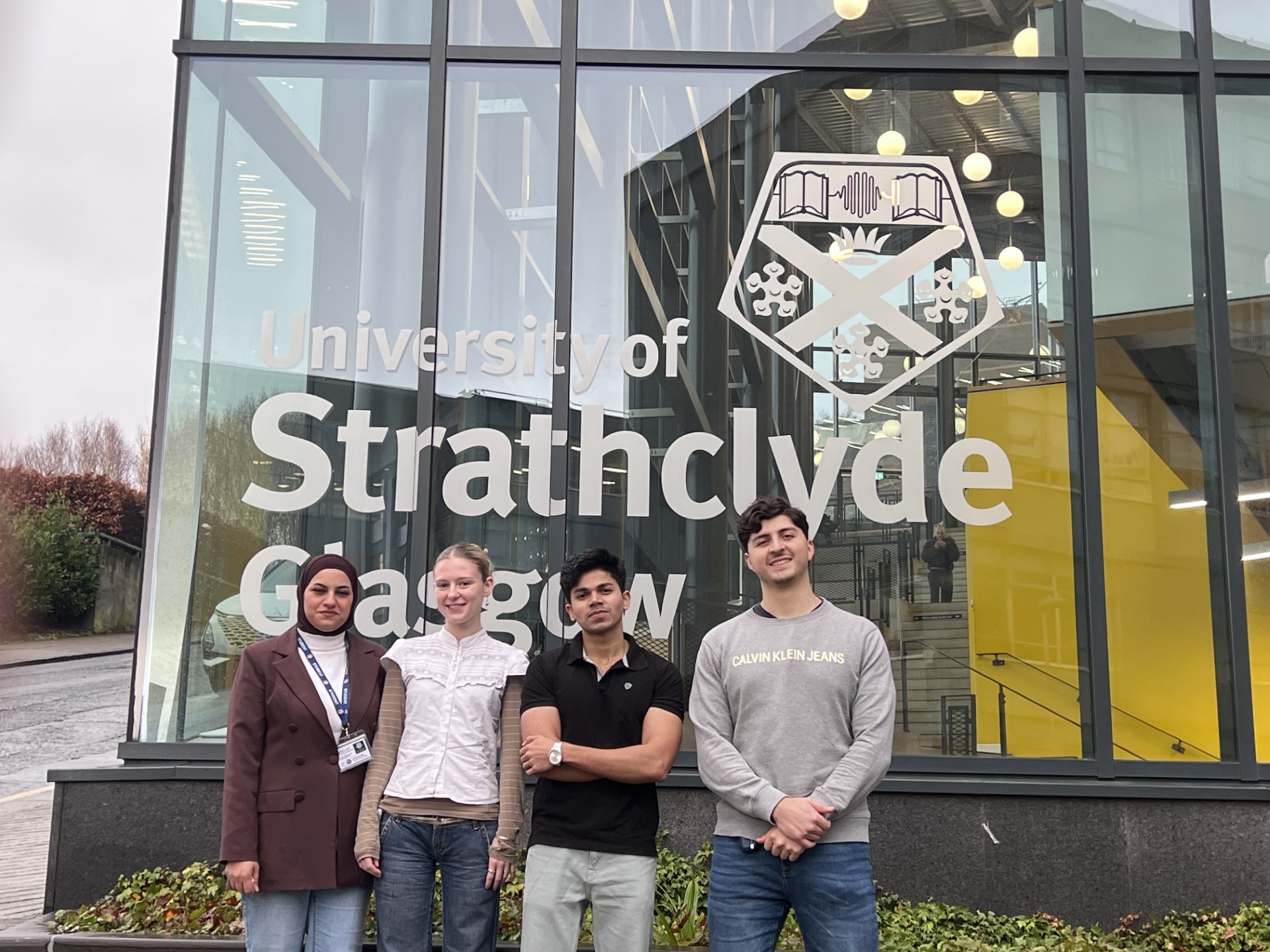
The students - two from the Department of Economics and four from the Department of Electronic and Electrical Engineering (pictured) - have formed a single Strathclyde team, bringing together expertise from both departments. The interdisciplinary team will compete with students from selected universities across the UK and Europe, showcasing Strathclyde’s strength in collaborative, cross-disciplinary education.
Running from October 2025 to February 2026, the Challenge comprises six online sessions in which students work with Siemens Energy specialists to develop innovative solutions for future energy transition pathways. Teams adopt defined roles – including Gamechanger, Strategist, Implementer and Playmaker – reflecting industry practice and the multidisciplinary nature of energy innovation.
The Strathclyde team has proposed a concept for a “battery passport”, aimed at improving traceability for utility-scale batteries by linking technical performance data with environmental footprint information. The idea supports wider efforts to decarbonise energy systems while increasing transparency across supply chains.
Participation offers students valuable professional development, including industrial insight, international networking and practical experience. The winning team will be hosted at Siemens Energy’s Innovation Centre in Berlin, with the opportunity to tour the company’s Gas Turbine Factory, while successful teams will also receive gift vouchers.
The Challenge complements the students’ MSc studies and highlights the value of combining engineering and economic perspectives to address complex global energy challenges.
Business school student Molly Seeley said, “Taking part in the Siemens Energy Student Challenge has highlighted the value of collaboration and the sharing of ideas. Working alongside engineering students encouraged us to think beyond our own discipline. From an Economics perspective, this involved focusing on incentives, scalability and long-term sustainability. Our contribution focused on how battery passport regulation and energy management system (EMS) data can improve market transparency and decision-making across the battery lifecycle.”
Engineering student Santiago Escobar said, “We applied to the Siemens Energy Student Challenge because it offered the chance to work on a real problem connected to the energy transition, rather than a purely academic exercise. We were particularly drawn to the focus on decarbonisation, which reflects the kind of work we are willing to do after graduating."
Explaining the challenge proposal, he added, “Our battery passport concept focuses on improving transparency around battery lifecycle data, including performance, degradation and end of life considerations. This matters for the energy transition because large scale battery deployment is increasing rapidly, and better data is essential for sustainability, reuse, recycling and informed investment decisions.”
Professor Pawel Niewczas, Graduate School Director in the Department of Electronic and Electrical Engineering, said, “We are absolutely delighted that our students from EEE and Economics have been selected for the highly competitive 2025/26 Siemens Energy Student Challenge. Their ‘battery passport’ concept is an outstanding example of interdisciplinary thinking, with real potential to transform industrial-scale battery supply chains and accelerate the energy transition. We are extremely proud of the team and wish them every success in the Challenge.”
Dr Nikolaos Danias, Director of MSc Economics and Policy of Energy and Climate Change, Department of Economics, said, “This is a great opportunity for our students, who managed to conceive and propose a fascinating, applied and contemporary topic. The “battery passport” idea has the potential to be part of attempts to support: supply chain operations, theories of international trade, and regulatory support for utility-scale batteries.
“The Siemens Energy Challenge offers those Economics and EEE students who participate the opportunity to engage with a significant industrial partner, to interact with students from other universities, and to present their ideas in an international stage. We are very proud of the great work that the team has done, and we hope that they will succeed in fully exploring what this process has to offer to them.”
The student team comprises Al-Bahhash Ghadeer Saad Abduljaleel (MSc 5G Advanced Communications); Saoirse Fletcher Dunne (MSc Renewable Energy and Decarbonisation Technologies – REDeT); Santiago Andres Cubillos Escobar (MSc REDeT); Alan Rajesh Thali (MSc REDeT); Anderson Black (MSc Economics and Policy of Energy and Climate Change); and Molly Seeley (MSc Applied Economics).
Pic shows from left to right: Ghadeer Al-Bahhash, Saoirse Fletcher Dunne, Alan Rajesh Thali, Santiago Cubillos. Missing: Molly Seeley and Anderson Black.
Published: 21 January 2026