Economics academics take RSE-funded collaboration to IIASA in Vienna
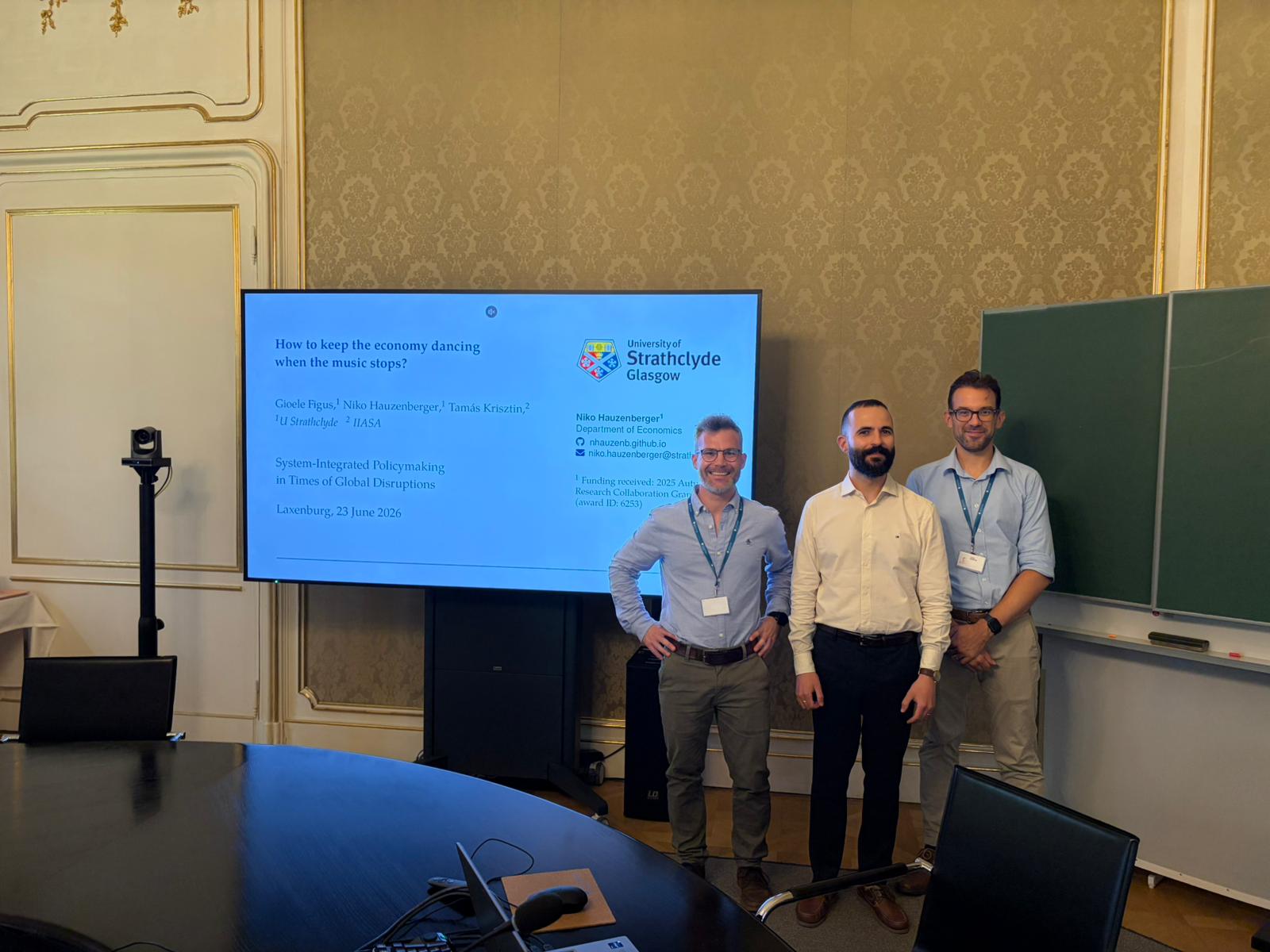
Dr Niko Hauzenberger and Dr Gioele Figus from the Department of Economics completed a two-week research visit at the International Institute for Applied Systems Analysis (IIASA) in Laxenburg, near Vienna, in June as part of a project funded by a Royal Society of Edinburgh Research Collaboration Grant.
The funded project - “How to keep the economy dancing when the music stops: System-integrated policymaking in times of global disruptions” - combines Strathclyde’s expertise in modelling shock propagation through production networks with IIASA’s mission to provide science-backed guidance to policy makers worldwide.
The recent surge in price inflation, global supply-chain and trade disruptions, and geopolitical risk has underscored the need for integrated, evidence-based macroeconomic policy responses, which is where the expertise of the Strathclyde researchers comes into play.
At the core of the project is a macroeconomic model in which sectors are interconnected through a production network derived from input-output data (data on how sectors buy from and sell to one another). The model decomposes the total impact of a disruption on any given sector into direct effects and spillovers transmitted through other sectors, offering insights into economic resilience, helping to identify vulnerable sectors, and informing the design of more effective policy interventions. This project extends the application of the model by looking at the case of the European Union, which is of fundamental interest to IIASA.
The visit culminated in a workshop, “System-Integrated Policymaking in Times of Global Disruptions”, held at IIASA on June 23. The workshop was opened by Petr Havlík, Director of the Biodiversity and Natural Resources Program at IIASA. A first session on production networks and multi-sector input-output modelling included presentations by Dr Figus on assessing diet shifts and structural shocks in input-output frameworks, and by IIASA researchers Tamás Krisztin, Michael Wögerer and Michael Kuhn on IIASA’s global land-use model GLOBIOM, its links to the MAGNET model, and the microfoundations of macroeconomic land-use models.
A second session turned to advanced macroeconomic time series modelling and spatial econometrics. Dr Hauzenberger provided an overview of the project’s network model, Leo Ringwald (IIASA) gave a talk on connecting micro-level distributions to macroeconomic aggregates, and Michael Wögerer on the regional determinants of rural attractiveness in Europe. Dr Figus closed the workshop with a synthesis of collaboration pathways and future joint funding opportunities.
Dr Hauzenberger said, “The workshop was a fantastic opportunity for research exchange and food for thought, and it fitted the theme of the project exactly. We are very grateful to the Royal Society of Edinburgh for making both the research visit and the workshop possible, and to everyone at Strathclyde and IIASA who made it such a stimulating day. We hope this is just the start of a lasting partnership.”
During the visit Dr Figus also presented joint work with Dr Geoffroy Duparc-Portier, Professor Graeme Roy and Professor Peter McGregor on redistributing the gains from trade across three dimensions of inequality, carried out as part of the Centre for Inclusive Trade Policy.
Work now continues on refining the model in response to feedback from IIASA users and finalising an off-the-shelf code package, with a view to testing the model on a concrete policy issue and scoping joint funding applications.
Published: 23 July 2026