


Overtourism or anti-tourism: that's the question, what's the answer?
By Richard Butler - Posted on 28 October 2026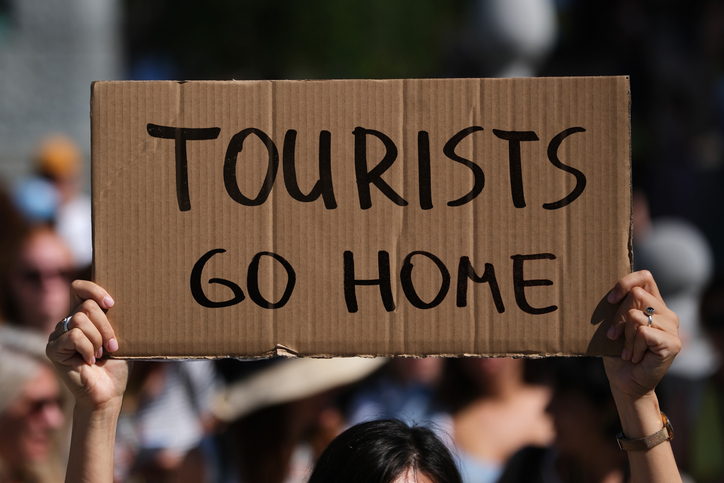
Emeritus professor Richard Butler examines the issues of overtourism and anti-tourism in today’s blog and looks at whether controlling tourism could benefit both tourists and locals alike.
Since tourism first began there have been complaints by various parties about the presence, behaviour and numbers of tourists. In relatively recent times, the art critic John Ruskin complained of what he termed ignorant tourists in Venice who knew nothing about the city or its architecture, particularly his three volumes on the subject. At the end of the 19th century upper class tourists complained of the new type of tourist that Thomas Cook was bringing on his tours to Egypt. Closer to home, local residents in the Highlands in early 1800s complained about what we may call ‘proto-tourists’ who rented large estates for deer hunting and salmon fishing. These are not complaints about overtourism or excessive numbers of tourists but about the characteristics of the tourists involved.
Currently there are numerous complaints of overtourism from many parts of the world, mostly now by residents of tourist destinations or by academics and travel writers rather than by other tourists. These complaints include too many tourists, excessive and inappropriate development related to tourism, the loss of traditional shops and services to tourist focused replacements, disturbance in residential parts of cities, general inappropriate behaviour, noise, litter and overall crowding of popular places. The number, the scale and the range of locations involved make it clear that what is termed overtourism is not a minor issue any more but is, at a localised level, a major problem not only for the tourist industry but for local governments as well and, more pertinently, overtourism is becoming anti-tourism.
Tourism is a complex phenomenon, with economic, social, cultural and environmental consequences, and while it is relatively easy to attract tourists and tourism investment and development, it is much more difficult to effectively control it. This is because tourism is comprised of a vast number of individual enterprises, from multinational corporations such as airlines and hotel chains, to individual bed and breakfast establishments or small cafes, each with different goals and ambitions. In many tourist destinations there are widely differing views on the scale, nature and growth of tourism, some parties wishing continued expansion, others wishing degrowth or limitation on further growth, and consensus or agreement is often difficult to reach.
Local governments may wish to limit or prevent further growth but face national level governments promoting tourism at the international level and also face private companies such as airlines and cruise ship lines able to operate beyond local control. Designations such as World Heritage Site listing may also attract more tourists than desired, and appearances of places on social media or in films and television programmes, for example Game of Thrones or Outlander can suddenly result in major increases in visitation, sometimes in locations ill-prepared for a tourist rush. The problems faced in Northern Scotland along the North Coast 500 is a good illustration of what seemed a reasonable idea to develop economic growth in that area turning into a series of problems, as well as benefits, for those living along the route. Inevitably many of the benefits accumulate to private commercial enterprises, while many of the disbenefits - excessive traffic, inconsiderate driving, litter, toilet waste, and inappropriate parking - fall to local residents and public services.
The main problem in most cases is that globally tourism is continuing to grow: more people, more with enough money to be able to take a holiday, cheaper, faster and more available travel, and mass marketing all result in more tourists. Most destinations initially were keen to grow; Barcelona is an excellent example of a city wanting to develop tourism in the 1990s, successfully holding the Olympic Games and promoting tourism heavily, but now facing growing and angry protests about the impact of tourism, particularly on housing, where the city has been remiss over several decades in establishing public housing provision.
Of all the complaints about tourism, its effects on housing availability for local residents is probably the major and most difficult one to resolve. The provision of facilities and services, especially accommodation, for tourists requires staff and, as many staff do not normally reside in the destination but are, like the tourists, seasonal visitors, they need somewhere to stay, thus competing with local residents for flats and houses. The rapid growth of AirBnB and similar agencies has compounded the problem with entrepreneurs purchasing individual and blocks of flats to rent to visitors. Apart from increasing competition, and hence prices, such developments bring tourists into previously locally dominated districts, sometimes causing problems over disturbance, noise, lack of parking and other problems. Add to that the issue of second homes and it is easy to see why there has arisen such opposition to tourists, generated by the non-availability of homes for local resident.
COVID19 is perhaps also partly to blame for the recent increase in complaints of overtourism since 2022. To many people in tourist destinations, the recovery of tourism following the pandemic must have seemed an incredible rise in tourist numbers, even when they were only returning to pre-COVID levels. Irrespective, there is little doubt that feelings against tourism and tourists have grown in many places over the last few years.
We are witnessing perhaps, a return to anti-tourist and anti-tourism feeling as described at the beginning of this commentary. Residents and others in tourist destinations are now targeting not just the physical presence of tourism developments but the actual tourists themselves - shooting water pistols at them, posting signs and leaflets telling them to leave, and holding mass protests against tourism. The stage has been reached when in some locations the issue is no longer simply excessive numbers but the very presence of tourists at all. Tourism needs to be controlled and, more importantly, to be managed in a pro-active rather than the current reactive mode. One hopes that it is not too late in some locations and that mitigation and moderation can prevail. There are too many benefits from tourism for residents, businesses and tourists themselves to see the phenomenon banished from areas such as Venice, Dubrovnik or Skye but changes in the management of supply and in the nature of demand have to be made in short order.






About Richard Butler
Richard Butler, a geographer, is Emeritus Professor of Tourism at the University of Strathclyde, having taught at the University of Western Ontario, the University of Surrey and Strathclyde University. He has consulted for numerous agencies, governments and for UNWTO, and has supervised over 40 doctoral students, published 30 books and over 200 papers and chapters in books. His main research areas are destination development, sustainability, tourism war and political change, indigenous tourism, and tourism in peripheral areas. He is a founding member and past-President of the International Academy for the Study of Tourism and in 2016 was awarded the UNWTO Ulysses medal for ‘excellence in the creation and dissemination of knowledge’.

