
Fair Work or Work in Progress? What Hospitality Workers in Scotland Are Telling Us
By Irma Booyens - Posted on 4 November 2026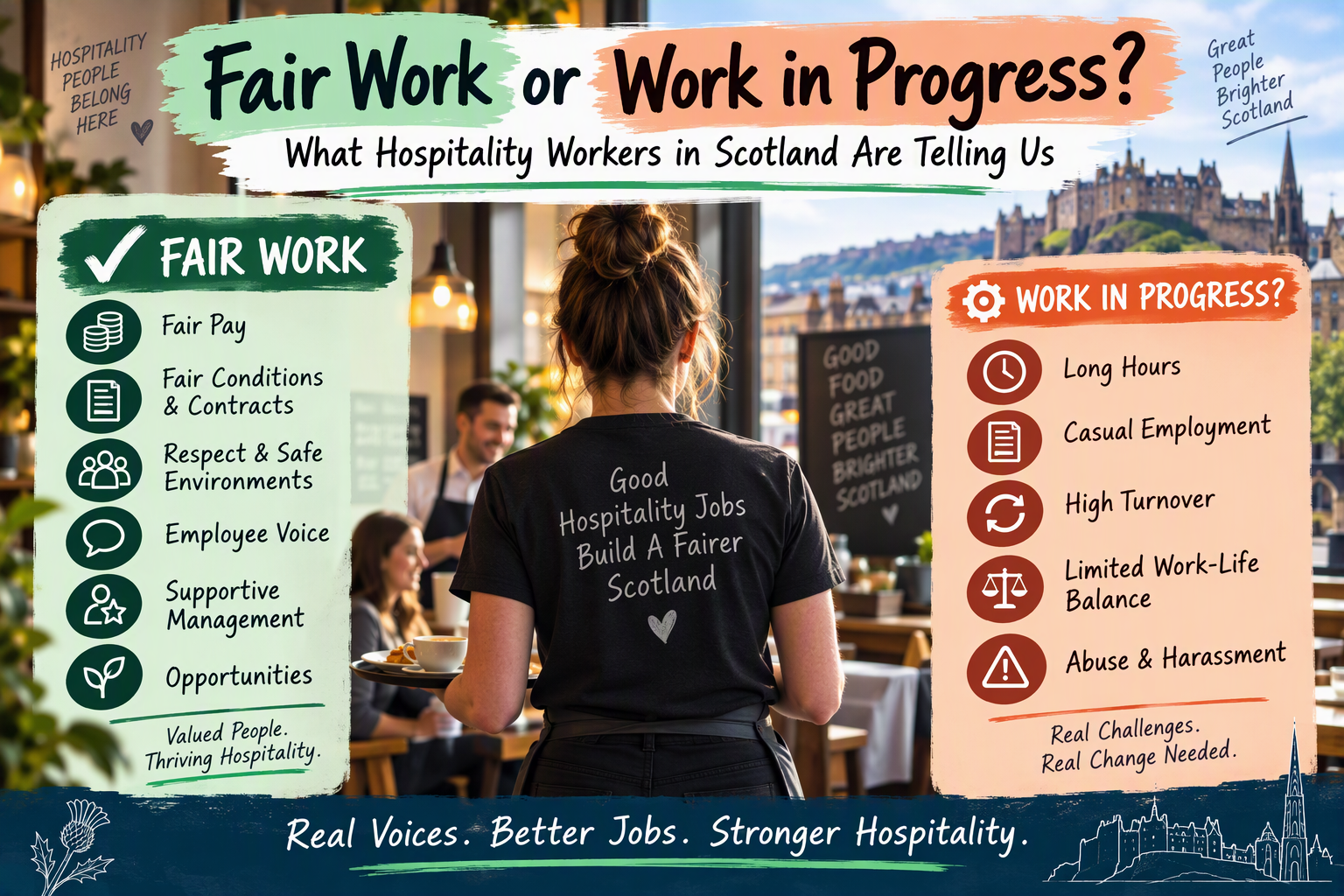
A group of Strathclyde Business School researchers have conducted a survey of hospitality workers across Scotland which has revealed the state of play of the Scottish hospitality sector. Here, Dr Irma Booyens outlines the survey findings and looks at what it means for the future.
Scotland’s hospitality sector is a major employer, supporting jobs across hotels, restaurants, cafés, pubs and tourism businesses. However, while the industry plays a vital role in the economy, questions remain about how work quality and conditions are experienced by hospitality employees.
A recent 2025/26 survey of 252 current and former hospitality workers across Scotland, conducted by researchers from the University of Strathclyde and Glasgow Caledonian University through the Global Hospitality Research Alliance (GHRA), examined employee experiences of fair work.
What was the survey about?
The survey explored five key dimensions of fair work: fair pay, fair contracts, fair conditions, fair management and fair representation. These principles are central to Scotland’s Fair Work agenda and provide a useful framework for understanding both the strengths and challenges facing hospitality employment today.
The research also builds on a similar survey undertaken during the COVID-19 pandemic in 2020, allowing comparisons over time and offering insights into whether working conditions have improved in the years since.
What did the survey find?
The findings present a mixed picture.
On a positive note, many respondents reported feeling respected by their managers and believed they were treated fairly at work. Permanent contracts were the most common form of employment, and there were signs of improvement in some areas since 2020, including greater use of written employment agreements and slightly higher levels of union membership.
However, significant challenges remain.
Pay and employment conditions
While most respondents earned at least the statutory minimum wage, fewer than one-third reported earning the Real Living Wage. Many employees were paid hourly rather than receiving a fixed salary, and some reported issues relating to holiday pay, sick pay and receiving payment for all hours worked.
The survey also highlighted ongoing concerns around job security. Around a third of employees were employed on zero-hours or temporary/casual contracts.
Many workers reported regularly working beyond their contracted hours, and results show that 42% of employees only sometimes get the rest breaks that they are entitled to by law.
Staff retention challenges
The hospitality sector continues to face difficulties retaining staff. Nearly one-third of respondents indicated they were likely to leave their current employer within the next year, while a substantial proportion were considering leaving the sector altogether.
The main reasons cited included better opportunities elsewhere, poor management practices, limited work-life balance and a lack of recognition for employees' contributions. These findings suggest that labour shortages and high staff turnover are likely to remain significant concerns for employers.
Workplace abuse remains widespread
Perhaps the most concerning findings relate to reports of ongoing workplace abuse and harassment in the sector. Only 17% of respondents indicated that they ‘never’ experienced verbal abuse. Around 60% had experienced psychological abuse, and nearly half (48%) reported experiencing sexual harassment at least some of the time. Customers were identified as the most common perpetrators, followed by co-workers and managers.
Equally troubling was the finding that many employees chose not to report incidents. Reasons included a belief that no action would be taken, a lack of trust in management and uncertainty about reporting procedures. Importantly, these patterns closely mirror those found in the 2020 survey, suggesting that progress in tackling workplace abuse has been limited.
What does this mean for the future?
The findings demonstrate that creating fair and sustainable hospitality workplaces requires more than improving wages alone. While pay remains important, employees also value respectful management, predictable working arrangements, safe working environments and opportunities to have their voices heard. Addressing workplace abuse/harassment, strengthening employee wellbeing and improving management practices are therefore central to improving work in the sector.
For hospitality businesses, investing in fair work is essential for attracting and retaining employees, while policymakers have an important role to play in promoting fair pay, reducing insecure work and strengthening protections against workplace abuse. The findings highlight that fair work is ultimately about dignity, respect, security and being valued at work, and that addressing these issues will be critical to the future of Scotland's hospitality sector.
The research team comprised of Irma Booyens; Anastasios Hadjisolomou; Tom Baum; Hazel Baxter-Reid; Tayler Cunningham; Brian Finlay; Shayesteh Moghadas; and Dennis Nickson. You can find the full report here and a related publication here