


Climate Change: the bill Nepal cannot pay alone
By Chandra Thapa - Posted on 15 September 2026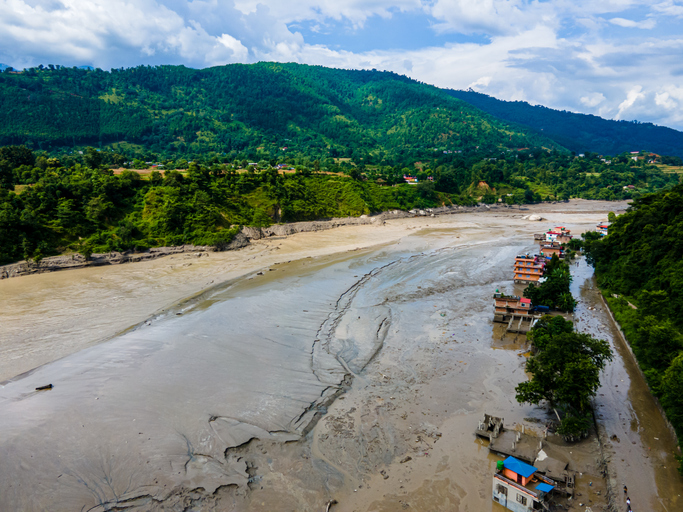
In today's blog, Professor of Finance at Strathclyde Business School Chandra Thapa writes about how the Nepal flash flood catastrophe exposes the gap between Nepal’s climate vulnerability and its ability to finance reconstruction and adaptation.
Houses lie completely or partially submerged in muddy water along a riverbank after flash floods hit Trishuli Bazar in Nepal's Nuwakot district last month.
On August 26, 2026, a large mass of glacier ice and underlying bedrock detached high on the Langtang Lirung massif, near the Nepal China border. The resulting rock and ice avalanche, debris flow and flood travelled down the Lhende Khola into the Bhote Koshi and Trishuli rivers. It swallowed settlements, bridges and the Rasuwagadhi border post. By 6 pm on September 8, Nepal’s disaster authority had recorded 1,358 deaths, with another 5,326 people still missing.
Scientists have not yet determined how much climate change contributed to this particular collapse. The physical mechanisms that can increase such risks, however, are well understood. Rising temperatures accelerate glacier loss and thaw mountain permafrost. The IPCC has concluded with high confidence that glacier retreat and permafrost thaw have reduced the stability of mountain slopes.
Across the Hindu Kush Himalaya, glacier loss has accelerated sharply. A 2023 ICIMOD assessment found that glaciers disappeared 65 percent faster between 2011 and 2020 than during the previous decade. A newer assessment published in 2026 found that the rate of ice loss across the region has doubled since 2000.
This is also the second major glacial disaster on the same river system in little more than a year. A supraglacial lake outburst in the Lhende catchment destroyed the border bridge at Rasuwagadhi in July 2025.
Nepal is not confronting isolated hazards in an unchanged Himalayan environment. A pattern of growing physical and economic risk is emerging.
The injustice at the core
Consider the cost. Finance Minister Swarnim Wagle has put the initial reconstruction requirement at US$4 billion to US$5 billion. That is close to a tenth of Nepal’s economy. The estimate remains preliminary, with the full damage assessment still under way.
The catastrophe damaged hydropower plants, bridges, roads, settlements and other infrastructure. Even that rebuilding estimate cannot capture the entire burden. Lost lives, destroyed livelihoods, disrupted businesses, lost harvests and foregone electricity revenue extend well beyond the physical reconstruction bill.
Now weigh that against Nepal’s responsibility for global warming. Nepal produced about 0.05 percent of global carbon dioxide emissions in 2024. Its share of cumulative carbon dioxide emissions since 1751 is about 0.01 per cent. A country responsible for roughly one ten thousandth of historical emissions faces a reconstruction bill approaching a tenth of its annual economy.
That is the injustice at the heart of Nepal’s climate predicament.
The policy architecture
Nepal has not been passive on mitigation and adaptation. The National Climate Change Policy of 2019 provides the main policy framework. The National Adaptation Plan contains 64 priority adaptation programmes. Nepal submitted its third Nationally Determined Contribution in May 2025, committing to reduce net greenhouse gas emissions by 26.8 percent by 2035 against a business as usual scenario. It also remains aligned with the goal of achieving net zero carbon dioxide emissions by 2045. Nepal was also the first country to introduce climate budget tagging, beginning in fiscal year 2012/13. The difficulty is no longer the absence of policies or targets. It is finding the money and institutional capacity to carry them out.
The money
Meeting the quantified mitigation targets in NDC 3.0 is estimated to cost US$73.74 billion by 2035. Nepal expects to provide US$10.824 billion itself. The remaining US$62.916 billion, more than 85 per cent of the total, is conditional on international climate finance and support.
Adaptation needs are also enormous. The adaptation priorities in NDC 3.0 for 2025 to 2035 require another US$18 billion to US$20 billion, expected to come from international climate finance and support. The National Adaptation Plan puts the cost of its programmes through 2050 at US$47.4 billion. Nepal expects to contribute only US$1.5 billion, leaving US$45.9 billion to be mobilised externally.
A recent Climate Policy Initiative assessment puts Nepal’s climate financing gap at about US$6.7 billion a year by 2035. International development finance matters, but its scale and composition remain inadequate relative to those requirements. The Asian Development Bank and the World Bank Group together account for around 70 percent of Nepal’s development financing. Under its 2025 to 2029 country strategy, ADB expects to mobilise about US$2.3 billion in concessional ordinary capital resources, along with selective project based grants from the Asian Development Fund. Not all of this is climate finance.
The Green Climate Fund currently lists six projects involving Nepal, with total GCF financing of about US$157 million. Nepal’s climate requirements run into tens of billions of dollars.
The headwinds
Four obstacles stand out. First, much of the international development finance available to vulnerable countries still comes through loans rather than grants, increasing debt burdens precisely where fiscal capacity is weakest.
Second, access remains narrow. Nepal has three national institutions accredited for direct access to the Green Climate Fund. But the pipeline of institutions capable of preparing, financing and managing large climate projects remains limited.
Third, implementation capacity remains uneven. Nepal has had climate budget tagging for more than a decade, but the system does not by itself ensure that spending is prioritised according to climate risk or delivers measurable climate outcomes.
Fourth, climate and hazard data remain inadequate. That makes it harder to assess risks, design resilient infrastructure and prepare projects capable of attracting international finance.
Nepal therefore has work to do at home. It must improve project preparation, technical capacity, climate data and its ability to absorb larger volumes of finance, even as it demands more support from abroad.
What must be funded
The Rasuwa catastrophe provides its own priority list.
Nepal needs credible early warning systems designed for Himalayan hazards. It needs stronger monitoring of glaciers, glacial lakes and unstable mountain slopes. It needs roads, bridges, hydropower plants and settlements designed for the risks likely to emerge in the coming decades.
It also needs sustained investment in climate resilient agriculture, watershed management and water security. Sudden disasters attract attention. Slower changes in rainfall, snow and water availability can damage livelihoods across a much larger population.
Climate finance can no longer be treated as an environmental side budget. It is central to infrastructure planning, food security, fiscal stability and economic policy.
Why reconstruction cannot rest on new debt
Given Nepal’s negligible contribution to global warming and its limited fiscal capacity, the case for maximising grant based reconstruction finance is compelling.
If the preliminary estimate of US$4 billion to US$5 billion is broadly confirmed, Nepal should seek to finance as much of the reconstruction as possible through grants and other highly concessional support rather than relying primarily on new sovereign borrowing. That support should come through a combination of bilateral partners, multilateral institutions and international climate and loss and damage mechanisms.
Those responsible for the overwhelming share of historical emissions should bear a larger share of the costs falling on countries that contributed almost nothing to the warming of the planet. The warming that is increasing cryosphere risks across the Himalaya was overwhelmingly generated by emissions elsewhere.
Making Nepal borrow heavily to rebuild after disasters occurring in this changing environment would make the country pay twice. First through lost lives, livelihoods and assets. Then through years of debt service.
The macroeconomic case is equally strong. Financing reconstruction mainly through new loans would increase future debt service obligations and reduce the fiscal room available for health, education, infrastructure, adaptation and preparation for future disasters.
That risks creating a vicious cycle. Nepal borrows to rebuild assets destroyed by climate related hazards, then has fewer resources available to make their replacements resilient to the next disaster.
International grant mechanisms provide part of the foundation for a different approach. ADB says Nepal is eligible for selective project based grants from the Asian Development Fund. The Fund for Responding to Loss and Damage was created specifically to assist developing countries particularly vulnerable to climate change. Under its current funding arrangements, disbursements are made as grants. Nepal’s own NDC prioritises grants for adaptation and loss and damage.
But these mechanisms are nowhere near large enough on their own. As of March 2026, only US$822.06 million had been pledged to the Fund for Responding to Loss and Damage globally. Nepal’s preliminary reconstruction requirement from a single disaster is several times that amount.
That gap is precisely why Rasuwa should become more than another appeal for emergency assistance. It should become a test of whether the international climate finance system can respond at the scale climate vulnerable countries actually require.
The precise contribution of climate change to the Rasuwa catastrophe will continue to be studied. But the larger economic reality is already clear. Nepal is exposed to a rapidly changing Himalayan environment. Its adaptation needs run into tens of billions of dollars. Its domestic resources are nowhere near sufficient.
The bill is larger than Nepal can reasonably carry alone. Countries that contributed most to global warming should help pay it, without turning climate vulnerability into another source of debt.
This opinion piece was first published in New Business Age.






About Chandra Thapa
Professor Chandra Thapa joined Strathclyde Business School in 2012 as a Lecturer in Finance. Before joining the department he held two years of lectureship position at University of Stirling. His area of research relates to environmental, social and governance corporate financial risks. His teaching is primarily focused on Corporate Finance, International Financial Management, and Derivatives & Treasury Management.

